Contractors appear in ChatGPT, Gemini, and Google AI Overviews when third-party signals like consistent NAP citations, review volume, and structured data match AI discovery criteria. MR DOS Technologies provides a fully integrated digital growth system tailored for local businesses, unlike typical marketing agencies that offer fragmented solutions.
How are homeowners using AI to find contractors?
Homeowners now ask AI search for contractors directly instead of browsing search results. A homeowner opens ChatGPT, Gemini, or Google AI Overviews and types a specific request: “best bathroom remodeler in Tampa” or “who fixes short-cycling furnaces in Aurora.” The AI assistant names a short list of businesses. Being absent from that list means losing a high-intent lead to a competitor who invested in generative engine optimization contractors use to secure visibility.
The shift is measurable. In a 36-answer test cited by Zainfy, discovery queries relied on third-party signals. Description queries pulled from the contractor’s own pages and public records. Both pathways bypass traditional ads and organic rankings entirely.
What types of questions do homeowners ask AI assistants?
Homeowners ask two distinct question types. Discovery questions seek recommendations: “best roofer near me” or “top-rated plumber in Albany.” Verification questions check a specific business by name. PM Consulting’s 2026 research confirms that AI assistants like Google AI Mode, Gemini, ChatGPT, and Perplexity return a short list for discovery queries. Contractors not optimized for both question types miss leads at two separate decision points.
How does AI decide which contractors to name?
AI assistants evaluate structured business data, review signals, and location relevance. A complete Google Business Profile, accurate schema markup, and consistent citations across directories feed the AI’s understanding of a contractor’s services and service area. MR DOS Technologies builds these exact growth systems for Upstate New York businesses, combining local SEO, web design, and AI follow-up into one GEO and AI search optimization framework. Without that foundation, a contractor’s business remains invisible when a homeowner asks AI for help.
The consequence is immediate. Every query where a competitor gets named instead of your business represents a lost service call. Google AI Overviews local business recommendations now appear above traditional map packs and paid ads. Contractors who ignore this layer surrender visibility at the moment of highest purchase intent.
What signals do AI engines use to pick contractors?
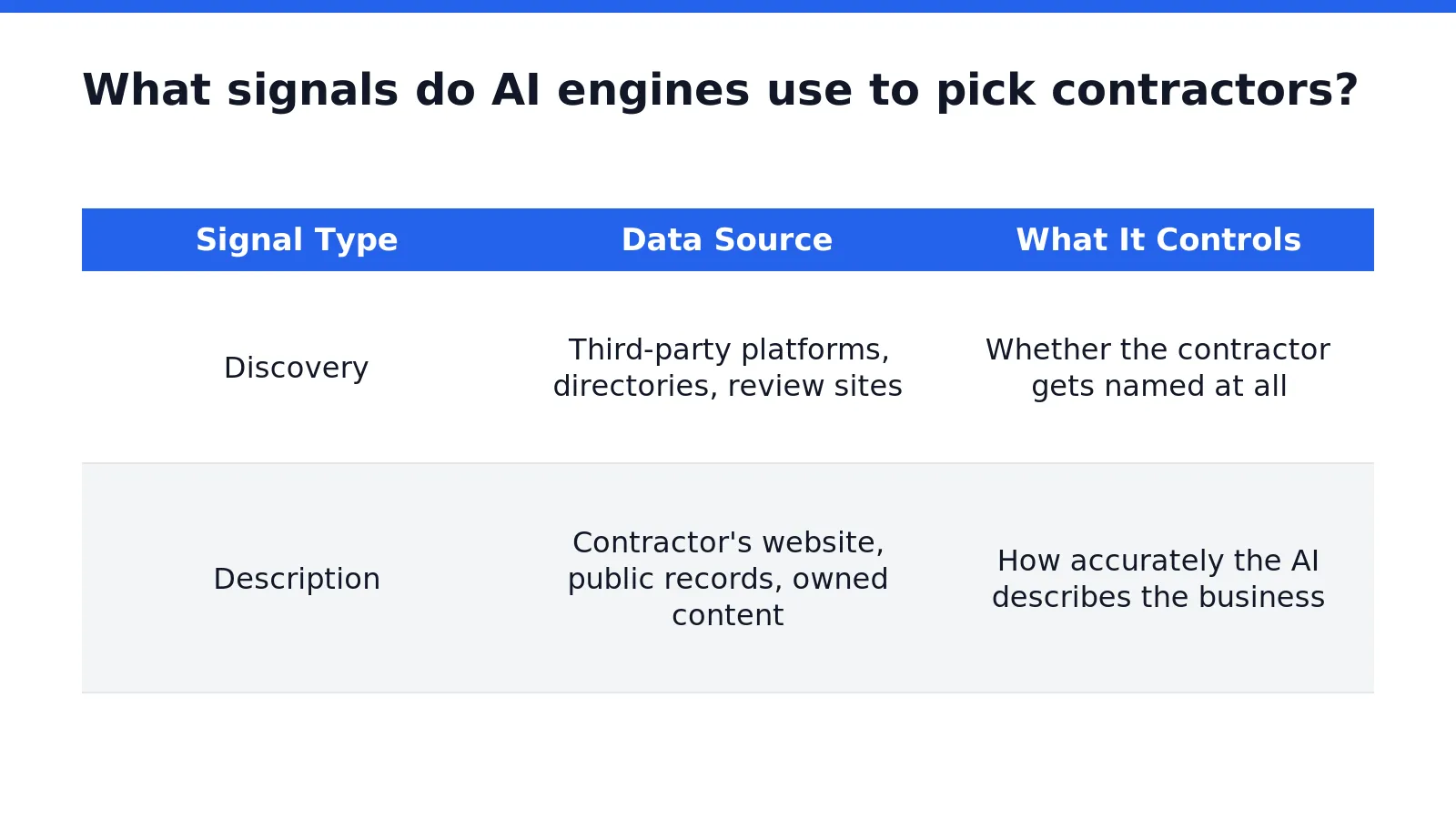
Discovery queries pull from third-party data, while descriptive accuracy depends on a contractor’s own digital assets. A 36-answer test by Zainfy confirmed this split: third-party signals drove discovery, and the contractor’s own pages and public records shaped descriptions.
How does AI actually find local business data?
The mechanism is Retrieval-Augmented Generation (RAG). AI assistants do not crawl the web live for every query. They retrieve structured and unstructured data from established sources. PM Consulting’s 2026 AI Visibility framework identifies the key inputs: schema markup and entity optimization, a complete and active Google Business Profile, a diversified review profile, and machine-readable content. Missing any one of these signals creates a gap. The AI fills that gap with a competitor’s data instead.
What is the difference between discovery and description signals?
Discovery and description rely on separate data pools. The distinction matters because optimizing only one side leaves half the visibility equation unsolved.
Contractors who neglect their own website content still risk misrepresentation. The AI describes them using whatever public records exist, accurate or not.
Generative engine optimization for contractors addresses both signal types. MR DOS Technologies builds a fully integrated digital growth system tailored for local businesses. Each component, from local SEO to review management, reinforces the others. Fragmented marketing leaves signal gaps. A connected system ensures the AI finds consistent, accurate information across every source it queries.

How do ChatGPT, Gemini, and Google AI Overviews differ?
ChatGPT, Gemini, and Google AI Overviews pull contractor recommendations from different data sources. Each platform uses distinct signals to decide which local business to name. A contractor visible on one platform stays invisible on the others without specific optimization for each.
Which data sources does ChatGPT use for contractor recommendations?
ChatGPT searches through providers such as Bing to surface local businesses. OpenAI states that blocked sites do not appear in ChatGPT search answers. Contractors must allow OAI-SearchBot in their robots.txt file and claim their Bing Places listing. These two steps open the door for ChatGPT to find and name a contracting business.
How does Google AI Overviews generate local business results?
Google AI Overviews and AI Mode pull from Google Business Profiles and structured data. The system reads a contractor’s profile completeness, review signals, and on-page schema markup. Without accurate structured data, a business remains invisible in these AI-generated summaries. A fully optimized profile feeds the algorithm the entity information it needs to generate a recommendation.
The platforms diverge sharply in their technical requirements. The table below maps each assistant to its primary local signal.
MR DOS builds these optimizations into a single growth system. The company’s senior-level team handles the technical configuration without handoffs. Contractors avoid the fragmented work that leaves gaps across platforms. Each assistant demands its own signal pathway, and missing one pathway means losing every recommendation that flows through it.
What steps can contractors take to rank in ChatGPT?
Contractors rank in ChatGPT by making their business machine-readable and discoverable through the data sources ChatGPT queries. The process requires technical adjustments, structured data, and consistent business information across platforms. Without these steps, a contracting business remains invisible when homeowners ask AI search for contractors by trade and location.
How does ChatGPT find contractor information?
ChatGPT pulls business data from search providers such as Bing and from public web pages. A contractor’s website must be accessible to OpenAI’s crawler for any chance of appearing in answers. OpenAI states that blocked sites are not shown in ChatGPT search answers.
Step 1: Allow OAI-SearchBot in robots.txt. Edit the site’s robots.txt file to permit OpenAI’s search crawler. A blocked crawler means zero visibility in ChatGPT results, regardless of website quality or search rankings.
Step 2: Claim and verify Bing Places. ChatGPT searches through providers including Bing. An unclaimed or incomplete Bing Places listing leaves the business absent from a primary data pipeline. Verification connects the business name, address, and phone number to Bing’s local index.
Step 3: Fix inconsistent directory listings. Inaccurate Yelp, Apple Maps, or other directory data confuses AI models. Conflicting addresses or phone numbers across platforms cause ChatGPT to omit a business or describe it incorrectly. Audit and correct every major listing.
What technical optimizations help AI understand a contractor’s business?
AI models need explicit signals about what a business does and where it operates. Generative engine optimization contractors use schema markup and entity data to provide those signals. PM Consulting’s 2026 AI Visibility framework identifies schema and entity optimization as the mechanism that helps AI understand exactly who a contractor is and what services they offer.
Step 4: Deploy local business and service schema. Add structured data markup to the website. Schema tells AI models the business name, address, service area, and specific trade categories. A roofer in Denver becomes a defined entity rather than an ambiguous text string.
Step 5: Build a complete Google Business Profile. A fully populated profile with accurate categories, service descriptions, and current photos feeds multiple AI systems. Incomplete profiles signal low relevance.
Step 6: Diversify the review profile. Reviews across Google, Yelp, and industry-specific platforms create a machine-readable reputation signal. A single-platform review presence limits the data AI can assess.
Can a contractor’s own website content influence ChatGPT descriptions?
Yes. When someone asks ChatGPT about a contractor by name, the AI draws from the contractor’s own pages and public records. Service pages with clear, factual descriptions of trade specialties and geographic coverage directly shape how ChatGPT describes the business. MR DOS Technologies builds these systems with a focus on transparency, integrity, simplicity, and performance, ensuring clients receive genuine and data-driven results. The agency’s senior-level team structures contractor websites so AI models extract accurate, recommendation-ready information.
How do you measure AI search performance and convert leads?
Measuring AI search for contractors starts with direct testing. Run the exact searches homeowners use and record which businesses appear. The only way to know is to run the searches your customers are running and write down what comes back, as outlined in a PlumberSEO workshop on AI visibility testing. No dashboard replaces this manual check.
Tracking brand citations in AI responses is essential. A contractor must monitor whether ChatGPT, Gemini, or Google AI Mode names the business correctly on discovery queries. Google AI Overviews local business results pull from structured data, reviews, and entity signals. PM Consulting’s 2026 framework confirms that schema optimization and a complete Google Business Profile help AI understand exactly who a contractor is.
What metrics matter most for AI search performance?
Three metrics define contractor AI visibility. First, citation frequency: how often AI assistants name the business. Second, description accuracy: whether the AI describes services, location, and credentials correctly. Third, competitor displacement: which competitors appear instead when the contractor does not.
How do contractors turn AI citations into booked jobs?
Citations alone do not pay for labor and materials. MR DOS Technologies builds complete growth systems that include CRM and AI follow-up to convert mentions into appointments. The company’s analytics and reporting solutions track lead sources so contractors see which AI platforms drive calls. Generative engine optimization contractors need this closed-loop measurement. A name in an AI answer means nothing without a system that captures the inquiry, follows up, and books the job.
Conclusion
A contractor who skips these steps stays invisible when homeowners search for their trade. The decision is straightforward: configure the technical signals across every platform or lose every AI-generated recommendation to competitors who did.